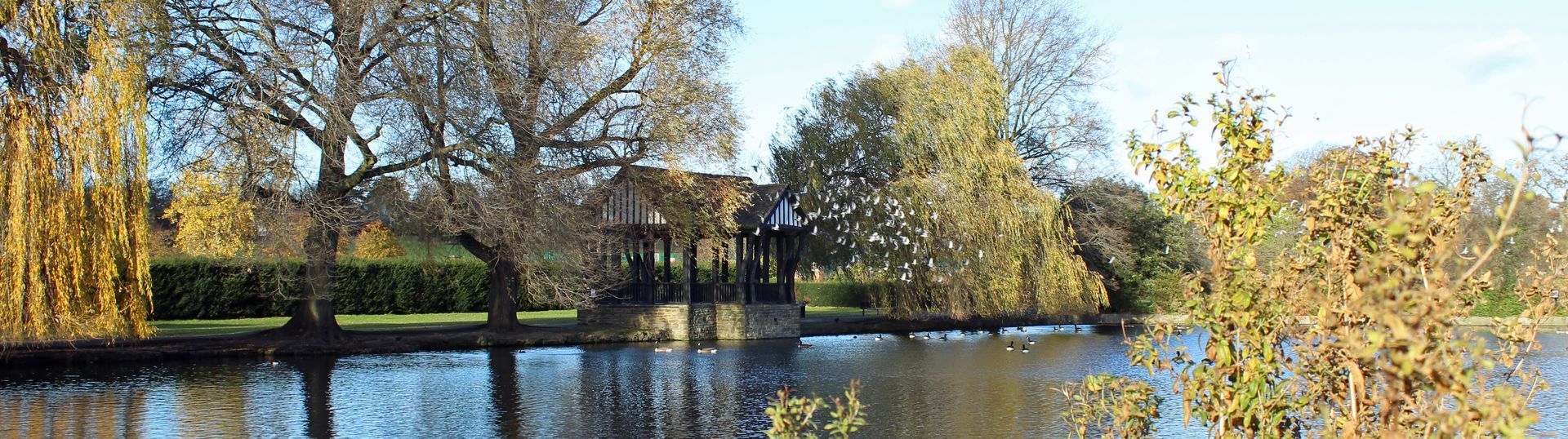
A Century on the Lakeside: A History of Broomfield Park Bandstand
The bandstand in Broomfield Park stands witness to a century of suburban transformation in North London. From its construction in the inter-war years to its modern-day use as a community performance platform, this timber structure has served as a social setting for the residents of Palmers Green.
I. The Victorian Prelude: 1861–1903
The origins of the Broomfield bandstand lie in a Victorian philosophy that viewed public parks as essential “oases of green” to alleviate the grime and polluted air of industrialisation. Philanthropic urban leaders believed that access to green spaces and good music “would free the mind of urban griminess” and humanise the landscape for the working classes. During the Victorian age, parks and public performance spaces developed across the towns and cities of the UK.
London’s first bandstand was a cast iron construction built in 1861 in the gardens of the Royal Horticultural Society, South Kensington. This vision of civilising entertainment was given legislative teeth by the London Council (General Powers) Act 1890, which empowered local authorities to fund and provide music in public spaces. By 1901, the London County Council (LCC) had already ordained the building of 22 permanent bandstands, aiming to improve both the quantity and quality of public performances.
In these early years, music performed in parks was seen as a moral influence, capable of transforming “disorderly” crowds into attentive, cultured audiences. As London suburbs like Palmers Green and Southgate expanded, the creation of high-quality park facilities became a point of civic pride and a tool for social improvement and cohesion.
II. A Public Park for Palmers Green: 1903–1925
In 1903, this municipal movement reached Palmers Green when the Southgate Urban District Council purchased Broomfield House and its 54-acre grounds for use as a public park. From its earliest incarnation, the District Council had ambitions for Broomfield Park to become an excellent public facility.
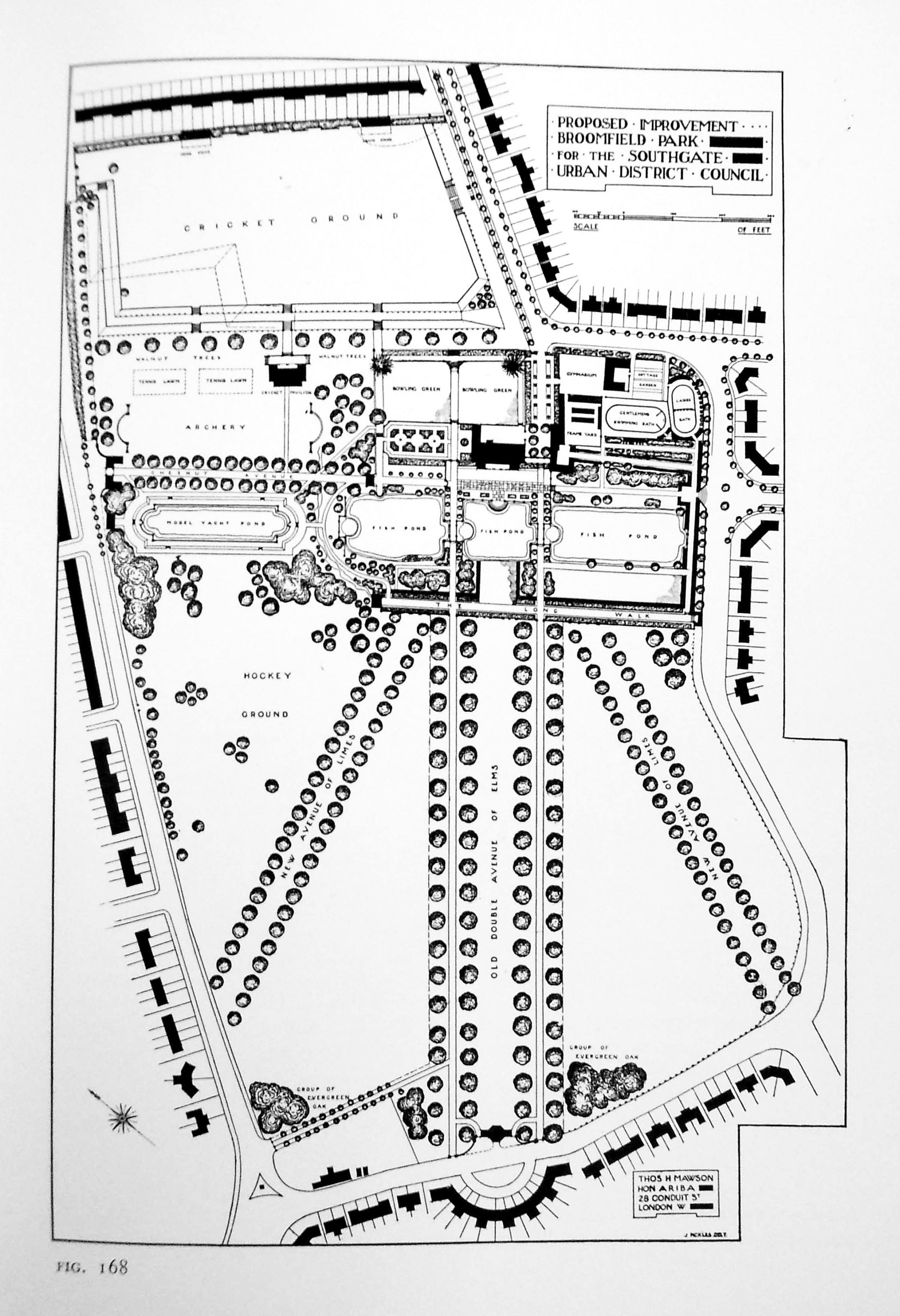
In 1905 prolific landscape architect and garden designer Thomas Hayton Mawson (1861–1933), was engaged by Southgate District Urban Council (SUDC) to create a master plan for Broomfield Park; his influential book, “The Art and Craft of Garden Making” (1911), records an unexecuted plan for Broomfield. However, no bandstand is included in his design.
Mawson's career started with private commissions for individual landowners focussed on creating seclusion and showcasing status, His practice expanded into tackling the challenge of adapting designs for newly established municipal parks, organising functional public space capable of withstanding high footfall and providing modern recreational amenities.
Mawson was appointed by the council but concerns were raised from residents and some councillors about the cost of purchasing and maintaining the park –which added a penny on the local rates.
Fiscal constraints of a cautious local authority resulted in a pragmatic response from the council. Incremental park improvements were implemented, rather than a grand design. However, the very act of commissioning a high-profile and influential landscape architect signalled a transition in how suburban councils viewed their responsibility to the public realm.
The council continued to invest in the park, providing drainage in 1907 and laying out sports facilities for cricket, tennis and football in 1908. By 1910, a dedicated boating pond was built on the northern edge of the park. Mawson himself was retained by SUDC as an advisor on the layout of Grovelands Park purchased in 1911. Throughout the 1920s both Borough Surveyor Mr. R Phillips and Chair of the Parks Committee Cllr John Joy were ambitious to develop the park further.
From very early on, music had been a feature in Broomfield Park. As part of the coronation celebrations or George V in 1911 The council arranged for a band to play during a Children's Fête. These concerts in the park appeared to be popular as, in 1912, The council sanctioned expenditure of up to £100 per year for band performances on Saturday evenings during the summer, allowing a cost of five guineas per performance.
During World War I, concerts were held to generate charitable donations. In 1915, in a concert aid of the Belgian Refugees Fund, performers included the Pipers of the London Scottish Regiment, the Palmers Green Choral Society, and the District Orchestral Society. In 1916, permission was also granted for monthly concerts in aid of the hospital at Grovelands House, which had been temporarily converted as a military convalescent facility.
There was significant growth in the number of brass bands after the First World War, often military in origin, players having previously served in local rifle volunteer corps. They were integral to community life, playing for local events and, in some cases, formed through public subscriptions or support from local businesses. In more industrial areas a factory band, or a pit band, was a common phenomenon. Public entertainment, located in parks and community spaces, delivered by working-class local people has been identified as part of a broader self-improvement or autodidactic movement in common with local co-ops and workers' education movements, attempting to create a “country fit for heroes” with a promise of health, prosperity and wellbeing for everyone.
In Broomfield Park, instead of a fixed bandstand, there was a rudimentary platform. However, sources indicate that performances often took place in existing open spaces. For example, a 1915 alfresco concert was held on the "sheltered lawn at the rear of the house" (Broomfield House).
In the post WWI period there was a move to deliver more suitable facilities for public concerts. Chair of the Southgate Urban District Council Parks Committee, Councillor John Joy said “... ever since Broomfield Park was Opened by the Council in 1903 it had been badly in need of a new and proper bandstand. The public liked to flock to the Park on Sunday evening, and good bands had endeavoured to play good music with everything against them.” The local newspaper commented: "it has been said, and rightly so, that the only blot upon the general beauty of the park was provided by the shed-like structure from which good music had to be disseminated”. A successful summer season of performances by the “All Bubbly Concert Party” in 1925 provided further impetus for investment in new facilities.
The Parks Committee resolved, in November 1925, to explore the building of a dedicated structure in a project led by Southgate Borough Architect and Surveyor, R Phillips, who would go on to design Broomfield’s Garden of Remembrance, opened in 1929.
III. Bandstand Design and Construction: 1925–1927
Unlike the ornate cast-iron "kiosks" typical of Victorian-era bandstands, the Broomfield structure was built in a mock-tudor "black and white" style.
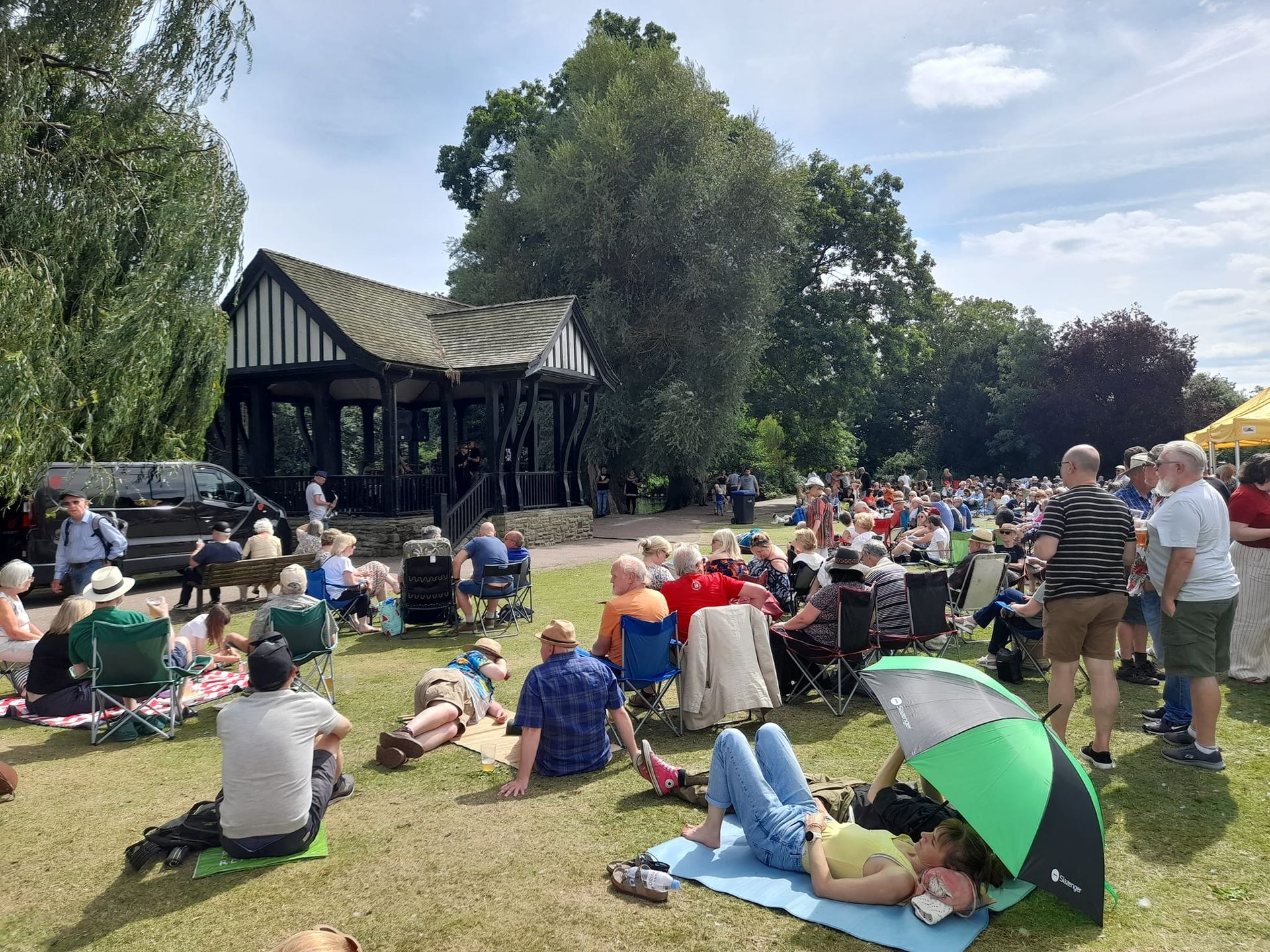
The bandstand stands on a stone plinth at the western edge of Broomfield Park’s southern lake. It is a wooden pavilion with a steep-pitched shingled roof over a small, raised platform and timber-framed walls with a short set of steps at the left-hand side. The structure presents more like a village hall than a classic bandstand, evoking mock Tudor or Arts-and-Crafts styling. Its timbering harmonised with the adjacent historic house which was planned to undergo a half-timbered refacing in the years after the construction of the bandstand.
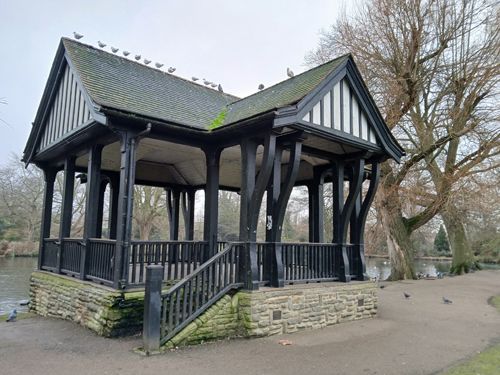
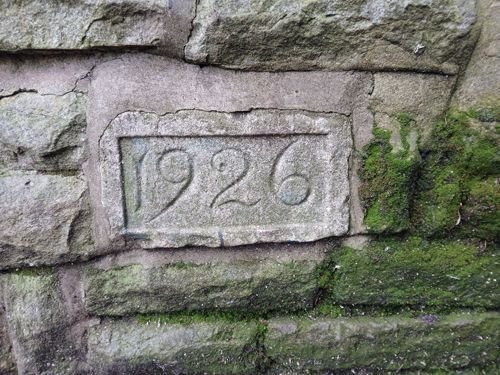
The mock Tudor transformation of Broomfield House was planned in 1929, but economic problems meant it was not completed until 1932. This type of cladding is a feature of many houses built in the burgeoning suburbs around this time. The official Parks Register entry describes simply a “half-timbered bandstand of 1926”, highlighting both the date and style. The date 1926 is inscribed on a basic plaque on the southern exterior wall.
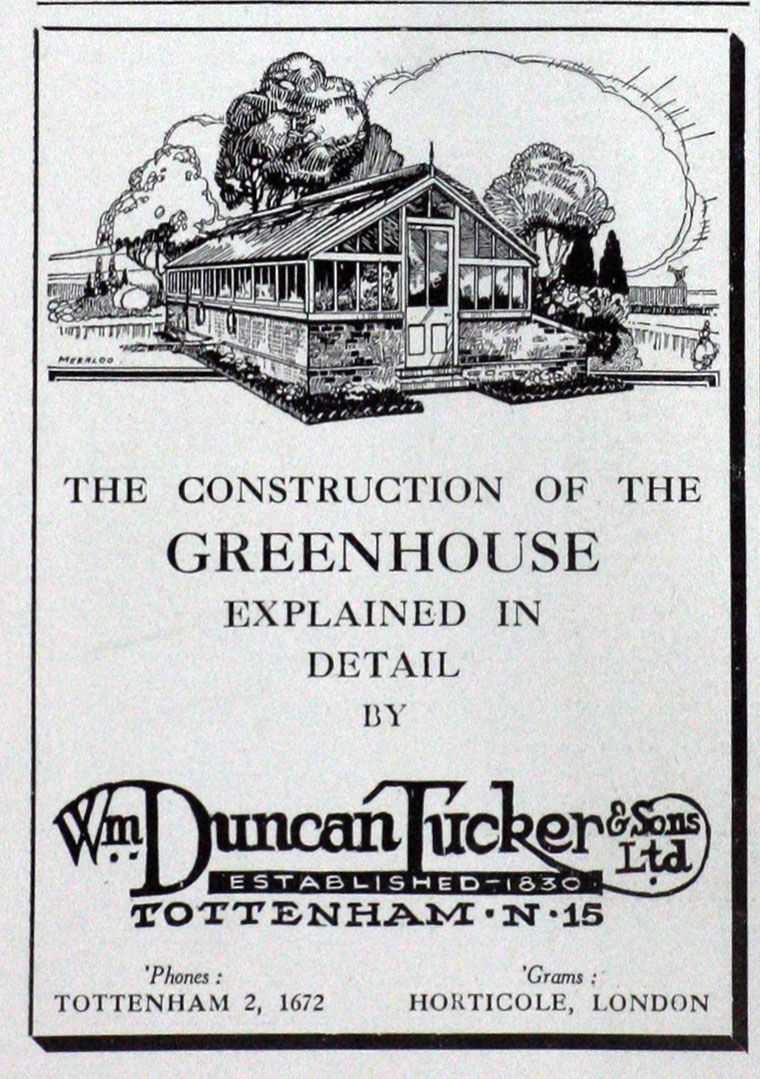
Much was made of the construction and materials; at the public unveiling of the new bandstand Mr. George Fullbrook, J.P., the chairman of the Southgate Council said: “the bandstand, like the park itself", was "all English." It was constructed of good British oak and of Somerset stone, and will remain as a monument to the enduring qualities of everything that was truly British."
Borough Surveyor, Mr, R Phillips, commissioned William Duncan Tucker & Sons, a prominent horticultural builder based locally in Tottenham, to design and build the bandstand. The firm specialised in prefabricated iron and timber structures, including greenhouses, cricket pavilions and other park amenities. They were a known supplier for parks in London and elsewhere across Britain.
William Duncan Tucker & Sons published a comprehensive catalogue of prefabricated designs which allowed councils to quickly and affordably add high-quality, decorative elements to support growing suburban communities.
The contractors would deliver prefabricated materials and construct on-site. However, William Duncan Tucker & Sons did not list bandstands in their catalogues; the Broomfield Park Bandstand was designed and built as a unique structure. The firm had previously, although rarely, delivered bandstands as bespoke projects such as the structure in Little Wormwood Scrubs in 1904 .
Borough Surveyor, Mr. Phillips, was commended by the parks committee for managing the project; “the initial cost of new bandstand had been estimated to be £800, but owing to Mr. Phillips's valuable advice and assistance the actual cost of the building had been kept down to £730” In 1931 improvements were made to the bandstand with the installation of an electricity supply at a cost of £26 1s. 4d
IV. The Opening Ceremony 23rd April 1927
On St George’s Day 1927, in a blaze of municipal pride, the bandstand held its first concert and a grand opening ceremony. Although the timing clashed with the FA Cup Final at Wembley between Cardiff City and Arsenal, the local newspaper reported on the well-attended and joyful celebration. They wrote: “Today it would not be beyond the bounds of reason to assert that the new bandstand in Broomfield Park is without its equal in London, not only for its structure, strength and acoustic properties, but also for its beauty of design and setting.”
A programme of music was presented to the assembled ceremonial party by the Highgate United Silver Band, conducted by Mr. G. Hutchins.
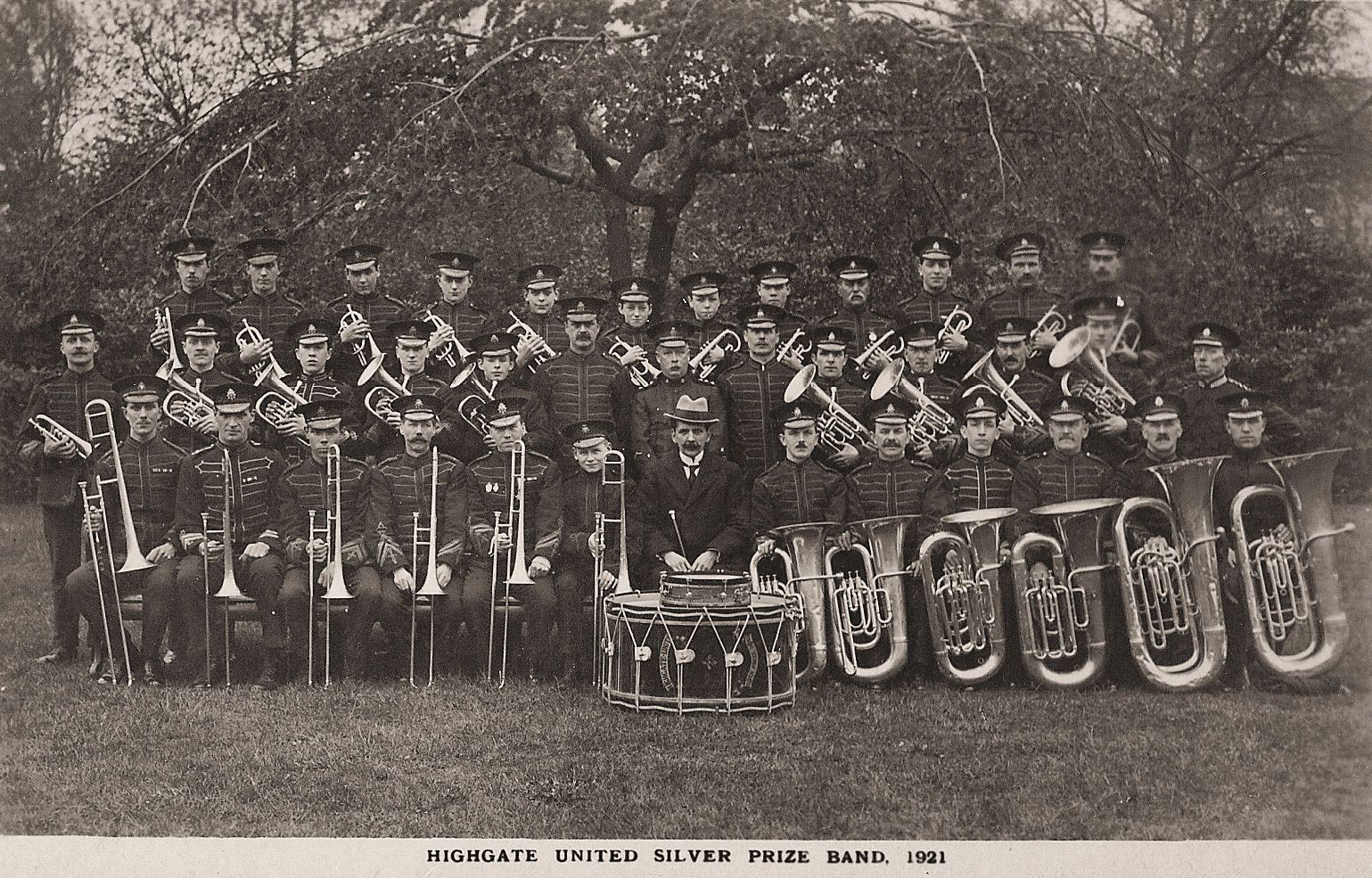
The occasion provided an opportunity for chairman of the Parks Committee, Councillor John Joy, to set out his manifesto for Southgate Urban District Council’s investment in public parks and community entertainment, “We live in a day of slogans," Mr. Joy said, "and one continually hears such things as ‘Eat more fruit’, ‘An apple a day, etc’. The slogan of the Parks Committee will always be 'Only the best is good enough for Southgate’ ”.
Councillor Joy continued “The Council back up the Parks Committee in the belief that the parks are the Best Centres for Communal Life. Our parks are a good investment that will repay a substantial dividend in the form of a strong, virile and healthy posterity. Parks are the best health department that any local body could inaugurate. All doctors would agree”, he said, that “preventive methods were infinitely better than curative ones. One visit to the playgrounds in the park, where the happy laughter and sparkling eyes of little children abounded, would be sufficient to convince the most hardened sceptic”.
The newspaper commissioned professional musician, Mr. Herbert Field master of Enfield Silver Prize Band, to conduct a review of the new bandstand. In glowing terms, he declared “I am very strongly of the opinion that Southgate's bandstand is the best in London. It is even better than the stands in the Royal Parks” In his professional opinion he thought the best sound could be heard from the opposite side of the lake saying: “Undoubtedly even in the softest passages, the music sounded more clear and with a better blend than it did in the immediate vicinity of the bandstand”.
V. The Golden Age of the Concert Green: 1928–1939
The decade following its construction was the bandstand's most vibrant era. The surrounding lawn, known as the "Concert Green," hosted an array of social activities.
During the first summer season in 1927 regular concerts featured the following performers:
- Gothic Military Band
- Wood Green Excelsior Silver Band.
- Highgate United Silver Prize Band.
- North London Military Band.
- Kings Royal Rifle Corps (1st C.B.).
- Enfield British Legion Band.
- North Middlesex Silver Prize Band.
- Special Constabulary Reserve "Y" Div. Band.
Over the 1928 summer season, the bandstand hosted the “All Bubbly Concert Party,” which attracted over 9,000 paying customers. It became a popular social ritual; on Sunday afternoons, crowds visited the park to sit in deck chairs or lean against railings to hear local brass bands perform free concerts. As well as band performances, the concert green was also used for dancing, chess tournaments and whist drives over the summer months.
VI. Wartime and The Coronation: 1939–1959
While the Second World War saw many park features sacrificed to scrap metal drives or turned into allotments, the Broomfield bandstand survived as a reminder of peacetime recreation.
Entertainment listings in the Wood Green and Southgate Weekly Herald from Summer 1951 list a range of activities on the bandstand including performance by West London’s Hanwell Silver Band, a talent show, whist drive and evening dancing on the concert green under the illuminations.
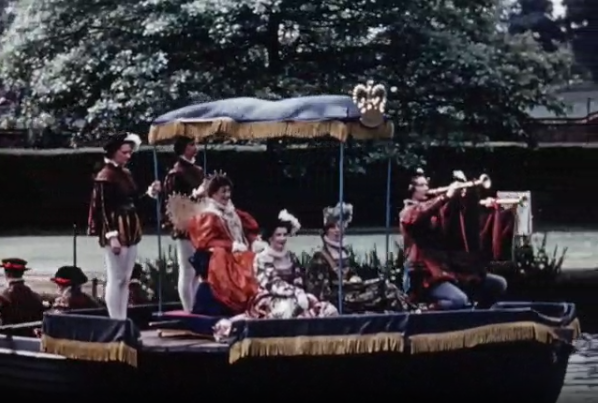
Broomfield Park and the bandstand were to host occasional civic celebrations, such as the 1953 Coronation pageant. Southgate’s week-long celebrations to mark the coronation of H.M. Queen Elizabeth II were focused on Broomfield Park, and included multiple events such as a chess tournament, a children’s pageant in Elizabethan costumes, and musical accompaniment.
As part of the celebrations, an actress dressed as Elizabeth I was rowed across the lake in a “royal barge” overlooked by the bandstand.
However, from the mid 1950s interest in traditional bandstand concerts began to wane across London as television and new forms of leisure emerged. Although Palmers Green was able to support two cinemas, The Queens and The Palmadium, home-based and individual leisure began to replace park-based, collective community entertainment of earlier decades.
VII. The “Silent Bandstand” Decline and Survival: 1960–2000
Throughout the 1960s and 70s, the park remained a popular spot for families to play, sail toy boats on the boating pond and enjoy the fresh air, but the grand brass band concerts of the past no longer took place.
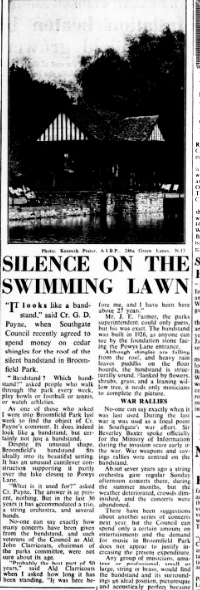
An article in the local press in August 1960xviii questioned Southgate Council's decision to spend money on reroofing the "silent bandstand” suggesting that no one knew when it was last used and many local park visitors were not even aware of its former function.
In stark contrast to the former civic pride in the structure, the article reports on councillors dismissively discussing the bandstand: “What is it used for?” asked Cr. Payne. Alderman John Clarricoats, chairman of the parks committee, was not sure about its age. “Probably the best part of 50 years,” he said when asked how long it had been standing, “It was here before me, and I have been here about 27 years.”
The journalist was convinced that the bandstand could be an attraction once again “The whole scene could be described as a miniature Kenwood, where the LCC concerts have been well supported”.
Another suggestion in the article was to convert the bandstand into an aviary. There was no investment in this idea and subsequently a different, dedicated aviary structure was built on the opposite side of the lake.
Broomfield Park was not alone - the late 20th century was a period of struggle for all London’s parks. Between 1979 and 2001, more than half of Britain's bandstands were demolished, vandalised or fell into disusexix. While Broomfield Park suffered the loss of its historic house to a series of fires from the 1980s, the bandstand remained a standing landmark amidst the park's cycles of restoration and decay.
VIII. The Modern Renaissance: 2014–Present
In the 21st century, the Broomfield Park bandstand has experienced a remarkable revival. It is no longer just a relic of the past but a working performance venue once again.
The launch of "Broomfield Blues," in 2014 saw the bandstand return to its former function as a platform for live music performance. This summer festival is organised by St. Harmonica’s Blues Club supported by the Friends of Broomfield Park. It is a well-attended and popular annual celebration of the weekly Southgate blues sessions. On the first four Sunday afternoons in August Broomfield Park comes alive to the sound of the best Blues music London has to offer. Entry is free and open to all with a voluntary donation to support the musicians.
Another historic element in Broomfield Park is the Memorial Shell this shaped Portland stone monument commemorates the public acquisition of the Park 1n1903. In 2020, the restoration of this memorial, by Broomfield House Trust volunteers, acknowledged the original civic leaders who took the bold decision to create a park for the local community The unveiling of the restored memorial by young pupils from Hazelwood School signalled a broader commitment to conserving the park's heritage features. Today the bandstand serves as a stage for the annual volunteer-led Palmers Green Festival and features diverse performers, ranging from community choirs to junior theatre groups.
IX. Conclusion
The Broomfield Park bandstand has successfully transitioned from a tool of Victorian social reform to a symbol of modern community spirit. Despite the loss of its parent house and the shifting tides of musical fashion, it remains a cherished lakeside feature. As local residents relax on the summer grass to listen to a community choir or a blues guitarist, they participate in a social ritual that has defined Palmers Green for one hundred years.